“Weaving the Space”, interview by Barbara Pavan
The thread is one of the mediums you most frequently use in your work. What was the determining factor for this choice? What expressive possibilities – and what limits – does the thread have in your artistic research?
Whether threads or hair, filaments are for me ideal tools with which to intervene in space and beyond. I am interested in them for several reasons: sustainability, functionality, and aesthetics. Sustainable because they are easily available, deeply connected to nature (the first conceived fiber is a natural one), and generally unprocessed, non-toxic materials. Their functional aspect is linked to strength, flexibility, and elasticity, which make them versatile and durable—well-suited to many uses beyond traditional weaving. By controlling the direction of each thread, it becomes like the trace of a pen that draws what the hand orders and the mind decides. When stretched, the threads resemble straight lines, becoming points of connection or junctions between elements, or visible trails of movement through space. When placed casually on surfaces or immersed in liquids, they evoke both the chaos of the cosmos and the sinuosity of forms known in nature—its perfection and imperfection. The way the material is treated also connects to aesthetic_reasoning. A limit that has often led me to question my decision to continue using it is the automatic association between thread and a certain image of the female figure, I'm referring to the less emancipated_one. Obedient, caring, patient, domestic, devoted to sewing and embroidery, waiting silently and dreamily for her man to return from work. A whole series of stereotypes representing a submissive ideal of womanhood, which I strongly oppose. Then I realized that renouncing this material for those reasons would mean submitting to my own prejudice, and so I simply set that thought aside.
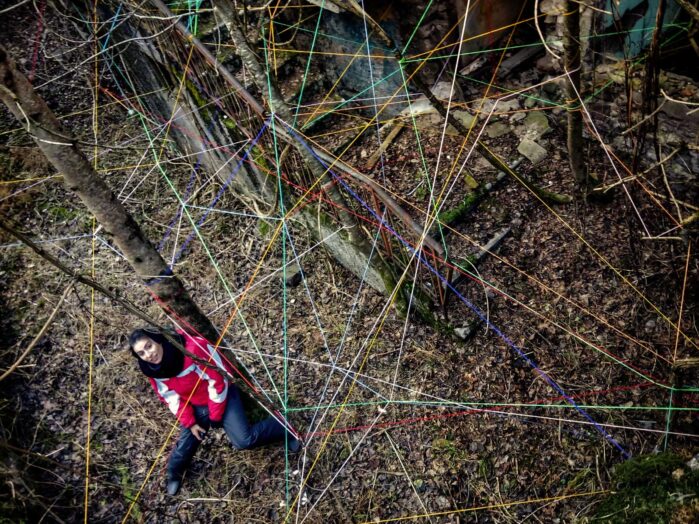
Pluripremiato a Paratissima 2019, il tuo progetto “Ambienti (Environments)” fotografa le installazioni realizzate con il filo all’interno di spazi abbandonati. Come ti relazioni con il luogo dentro al quale costruisci una nuova architettura? È un rapporto in divenire che si sviluppa dal momento in cui cominci ad essere parte di quell’ambiente oppure è un progetto che elabori e definisci a partire da un sopralluogo e prima della effettiva realizzazione?
The way I create the installations in the Ambienti (Environments) series follows my personal vision, built mentally through a long process of observing the chosen setting once I’ve identified the intervention site. Everything concerning the construction method, as well as the aesthetic and formal aspects of the project, is conceived from a specific point of view—the one from which it will later be photographed. As in George Rousse’s site-specific installations—which have strongly inspired my formal approach—perspective is essential to reading the composition. When I begin to “weave the space,” I become the pencil gliding across the page, shaping the scene; each single thread measures and records my steps as I move repeatedly through the space, seeking dialogue with it. Like a spider, I follow a hypnotic, slow, meticulous, and at times compulsive flow—often uncontrolled. The gesture’s rhythm depends on my emotions in the moment, and is therefore never entirely predictable. In short, alternate between control and randomnessjust as our existence constantly oscillates between reason and irrationality. Art that leaves no space for "caos/caso" - chaos/chance - becomes, for me, somewhat monotonous or merely decorative.
What does it mean to you to redesign a space that has been lived in and abandoned, dialoguing with its past and moving among the objects that bear its memories?
It’s important to clarify that the settings of my interventions are carefully chosen, as they are not simply “abandoned places of the past,” but what I define as “places of Modernity”: sites that, through their original function or architectural form, mark the historical and social transition from one era to another. Specifically, that moment in which everything—from everyday tools to living spaces, and even our very conception of life—was undergoing a radical transformation. And what became of what was no longer considered functional, aesthetically advanced, or suited to an increasingly fast-paced, consumerist existence? The answer, too often, was simply: nothing. It wasn’t even questioned. Yet I firmly believe that within every object or place—whether artificial or natural—there lies something greater: a complex story or a simple meaning worthy of attention. That’s why I bring into focus scenarios that no one seems to care about anymore—spaces whose voices have been silenced. And yet they still exist, carrying with them the full weight of their memories. When I encounter such spaces, I feel the need—almost a sacred impulse—to bring them my attention, my color, my touch, my time. The time I spend within them feels like an intimate dialogue between two strangers without a voice or time , who nonetheless long to know each other deeply, drawn together until they make love. This gesture — ephemeral, perhaps useless , and barely perceivable to those not physically present — poses a question: what is art, if not the aura behind an action? By filling static, lifeless ruins with unpredictable traces of color, I like to believe that these heavy blocks may become lighter, almost ethereal, momentarily reclaiming the center of the scene as they haven’t for ages.
The layering of memory—and, consequently, of human experience and emotion—is a recurring theme in your work. I’m thinking, for example, of the series "Multilevel", but also the performance "Catarsi Crisadelica" (Chrysadelic Catharsis), or the previously mentioned project on abandoned spaces. Is your art a voice that transforms individual experience into something universal, compressing time into an eternal present where past, present, and future can dialogue—or is it something else?
Absolutely. The motivation behind each of my works is deeply rooted in human intimacy and experience. Often, they draw on my own personal story to open pathways where others can recognize themselves. During my academic studies, I noticed my attention gravitating toward objects, tools, and places whose symbolic meaning I would only understand later. What interested me was exploring human behavioral dynamics, which required three key elements—without which, I believe, nothing would have been possible:sharp and patient observation, relentless curiosity , and the courage to personally venture into the complex terrain of experience.This process led me to conclude my studies with the performative project Catarsi Crisadelica (Chrysadelic Catharsis), an intimate work about human evolution and the struggle to detach from the known world to adapt to an uncertain, over-constructed, and disarming reality—far removed from the purity and simplicity that once governed it. Multilevel, a series of collages combining fabrics, threads, paper, and other materials, highlights multiple layers of interpretation, recalling the different planes of human experience..
Fiber-art installations are often monochromatic, but your works are always vibrant and colorful. What role does color play in your art?
Color, for me, quite simply represents vitality, strength, joy—but also hope, optimism, and openness. The combination of colors side by side acts as a powerful push against darkness and unease, both around and within us. During an exhibition some time ago, a young student told me while looking at the images of my installations in abandoned places: “Those taut, colorful threads are like children playing with their grey, rigid grandparents”. I think he perfectly captured my intention. The tension created by these colorful textile geometries—standing out in sharp contrast against the darkness and greyness of time — are like anchors to life. When I was 23, I moved from sunny, lively Sicily to grey Milan. I made a series of color sketches with ink, chose one of those abstract stains, and had it tattooed on my arm. Then, along my side, I had inscribed a line from a poem by Cesare Pavese that carries an optimistic promise: “Each new morning, I will go out into the streets seeking colors.” Those “colors” can easily be replaced with the words “peace” or “joy”—universally sought after. They are always with us; we just sometimes forget, or never realize it. Seeing that splash of color on my body reminds me that I already carry everything I need for my journey.
From thread to hair: how did you come to experiment with such a particular medium? What technical and symbolic qualities convinced you to make this choice?
Beyond the aesthetic, functional, and sustainable similarities between these two filamentous materials (though on different scales), I believe the main reason I began working with hair was its meaning in Western -or perhaps better said "Westernized"- society. At a certain point in my artistic path, I was addressing themes of prejudiceand modesty as products of socially constructed conventions. With the various series under Scorie Microcosmiche (Microcosmic Residues)my experiment took shape with a clear provocative, ironic, and experimental intent. By presenting the viewer with an object—an “artwork”—covered with textures made of hair, dust, crumbs, lint, and other micro-residues of daily life, the viewer was immediately confronted with their own inhibitions and discomfort. It was fascinating, and even amusing, to observe their reactions. After several experiments, I concluded—through my own subjective lens—that their responses to these small, defenseless elements mirrored their relationship with intimacy itself. When they laughed, I imagined they lived their intimacy with freedom and lightness; when they reacted with disgust, fear, or embarrassment, it likely reflected repression or discomfort toward their own bodies. Another reason for using this material is the theme of Presence/Absence of the human figure, which recurs in nearly all my works but becomes especially evident when working with such direct human traces. Hair, after all, is an extension of the body—anchored to it, carrying genetic information that endures through time. Yet “civilized” cultures have reduced it to something useless, unhygienic, and aesthetically unpleasant. On the head it’s considered essential—so much so that those who lack it seek transplants—yet once detached, even a single strand can evoke disgust. If you think about it, isn’t that strange?
What are your sources of inspiration, and how do your works take shape—from concept to realization?
I generally start not from a theme but from the expressive language I feel compelled to explore. For me, instinct and action are essential phases of creation, and I often discover the guiding thread only during the process. Many ideas I rework today originated as intuitions from childhood. My academic studies were fundamental, as were certain professors who conveyed the richness of the art world. Studying Graphic Design at the Academy of Fine Arts in Palermo provided me with strong aesthetic and technical foundations—photography, graphics, and digital tools applied to contemporary art, from concept to presentation. In those early Palermo years, my main interests were photography and street art. Later, I discovered contemporary languages that resonated more deeply and profoundly shaped my current work. Living in a metropolis like Milan, and delving into art phenomenology, sociology, philosophy, and cultural anthropology, my thinking evolved toward a critical reflection on contemporary society. I began to be inspired not only by visual artists but also by thinkers and their ideologies—particularly those with social engagement. Authors such as Serge Latouche, Guy Debord, Jean Baudrillard, Georges Bataille, Pier Paolo Pasolini, Michel Foucault, and Jacques Lacan have all influenced me. Yet, perhaps even more than these figures, I’ve been inspired by the artists, historians, sociologists, and anthropologists I’ve met in recent years—many of whom share libertarian ideals, consciously or otherwise.
What project are you working on now, and which would you like to develop in the future?
During the first half of this unusual year, in isolation and far from my loved ones (geographically far away from me), in Milan I felt compelled once again to reflect on human relationships, fragility, and adaptability—recurring themes in my research. This time, though, I also heard the cry of a wounded, exhausted, furious and violent Earth. As the echo of that violence spread around us, I felt compassion not for humanity but for Mother Earth herself. We living beings are merely guests in this vast home we’ve failed to care for—we’ve drained it dry. The Earth’s death is our responsibility. Out of this realization came a new series of works linking geographic representations of land fragments to tangles of human hair, prefiguring what Baudrillard might call a “hysteresia of the Earth” (quoting Baudrillard). Hair, beyond its sacred connotations in some cultures and its roots in ancient rituals, is—along with nails—the only part of the human body that continues to grow after death. During the summer, I created performances that served as Funeral Rites for the Earth. Inspired by ancient Greek rituals, I tore my hair to place it over the body—the land itself—which, once the ritual was completed, ending the ritual with: Spoglie (Spoils): layers of hair forming the faint outlines of the Earth’s continents, imperceptible and fleeting, like the memories of the deceased. And after death? I like to believe there is REBIRTH. I am currently preparing new material surfaces featuring continents shaped like recognizable yet non-existent lands—emerging from values such as respect for others’ freedom, equality with the different and the weak, rejection of domination and power, and denial of material greed. Hence their name: Continenti Utopici (Utopian Continents).
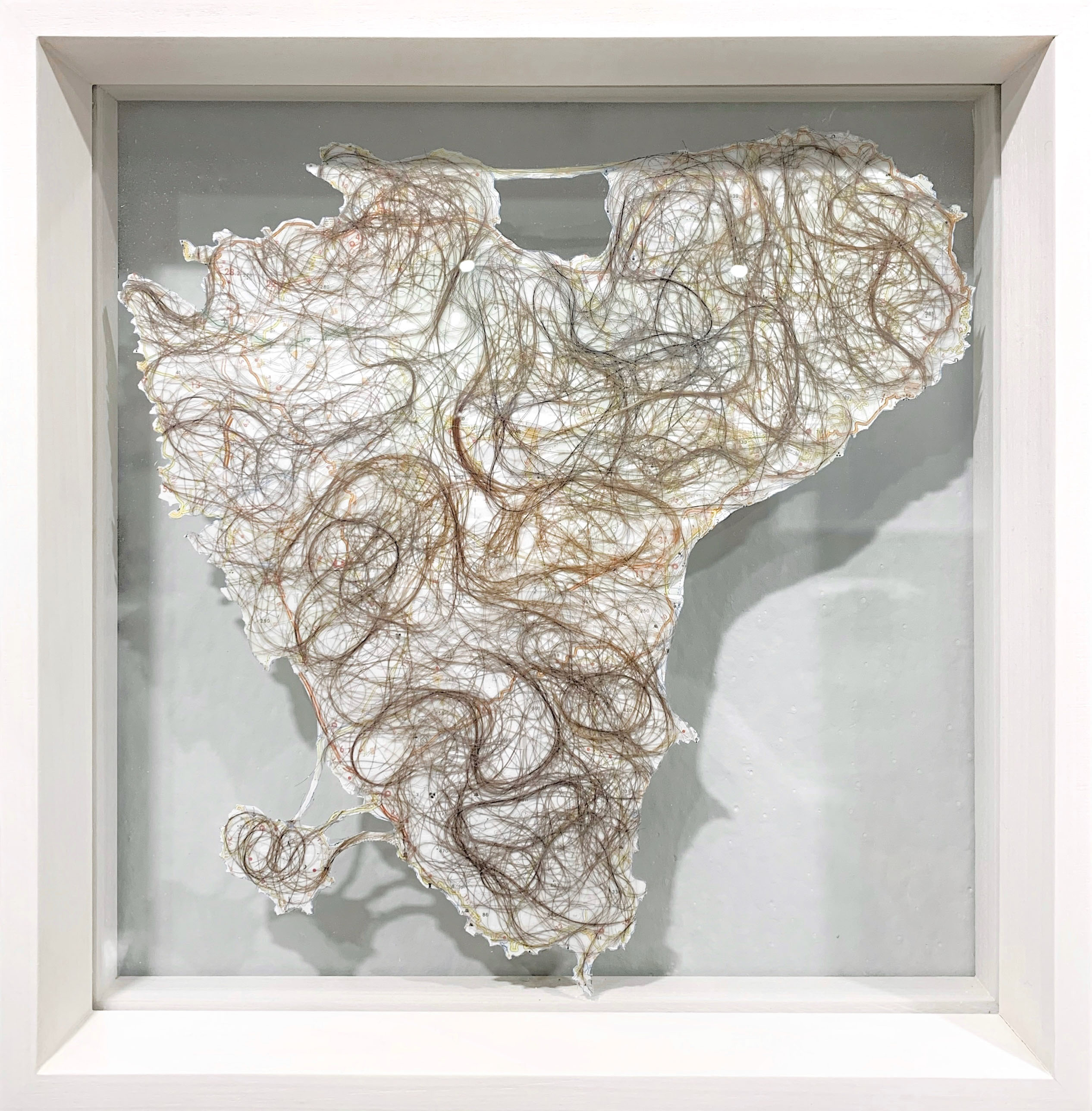
Continenti Utopici (Utopian Continents)
30 x 30 cm